Instructions For Authors
Preparation of Manuscripts for Submission
Submission of a manuscript confirms that the work and its findings are original, have not been published previously, and are not under consideration elsewhere. Submission also indicates that all authors have approved the manuscript and agree to its publication. Authors must disclose any actual or potential conflicts of interest.
Types of Papers
Bulletin of Education and Language considers the following types of manuscripts for publication:
- Original Research Articles
- Review Articles
- Theoretical and Conceptual Papers
- Classroom-Based and Action Research Studies
- Curriculum and Pedagogy Research
- Assessment and Education Policy Papers
- Case Study Reports
- Short Communications
- Research Methodology Papers
- Book Reviews
- Scholarly Commentaries
- Letters to the Editor
Style and Format
Manuscripts must be written in English. The text should be formatted using Cambria font, size 10.5, with single-line spacing (1.0) and one-inch margins on all sides. The paper size should be set to A4, and all pages must be numbered consecutively.
Length of Manuscript
There is no fixed word or page limit; however, authors are encouraged to present their work clearly and concisely. Manuscripts should preferably not exceed 30 pages, including tables and figures.
Manuscript Organization
Manuscripts should be prepared in the following order:
Title Page
TitleThe title should clearly reflect the content of the manuscript. Abbreviations should be avoided wherever possible.
Author Names and AffiliationsProvide the full name(s) of all authors. Affiliations should include department, institution, city, and country. The corresponding author’s email address must be provided and indicated with an asterisk (*).
AbstractThe abstract should be 150–250 words in length and briefly describe the purpose of the study, methodology, key findings, and main conclusions.
KeywordsProvide 4–6 relevant keywords to support indexing and discoverability.
IntroductionThe introduction should present sufficient background information to understand the study. Relevant previous research should be cited appropriately without excessive review. The research objective or hypothesis should be clearly stated.
Materials and MethodsThis section should include sufficient detail to allow replication of the study. Novel methods and modifications should be clearly described, while well-established methods may be cited without repetition.
ResultsResults should be presented clearly and concisely. The use of tables and figures is encouraged to enhance clarity.
DiscussionThe discussion should interpret the results and explain their significance rather than restating them. A combined Results and Discussion section is acceptable. Avoid extensive citation of previously published literature.
ConclusionThis section should summarize the key findings and contributions of the study.
AcknowledgmentsAcknowledgments may include recognition of individuals, institutions, funding sources, or grants that supported the research.
TablesTables should be numbered consecutively using Arabic numerals (Table 1, Table 2, etc.) and cited in the text. Table titles should appear above the table, while explanatory notes should be placed below the table and indicated with symbols (e.g., *).
FiguresFigures should be numbered consecutively using Arabic numerals (Figure 1, Figure 2, etc.) and cited in the text. Figure captions should be placed below the figures. All figures must have a minimum resolution of 300 dpi.
Model Tables and FiguresAuthors are encouraged to follow the journal’s model table and figure formats to ensure consistency and clarity.
Table 1. Students’ responses to a language learning questionnaire.
| Response category | Frequency | Percentage (%) |
|---|---|---|
| Strongly agree | 18 | 30.0 |
| Agree | 24 | 40.0 |
| Neutral | 10 | 16.7 |
| Disagree | 6 | 10.0 |
| Strongly disagree | 2 | 3.3 |
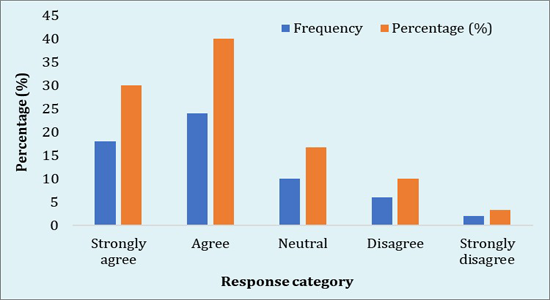
Figure 1. Frequency and percentage distribution of survey responses.
FootnotesFootnotes should be used sparingly and only when essential. Wherever possible, relevant information should be incorporated into the main text. If footnotes are used, they must be indicated by superscript numerals in the text and presented concisely.
ReferencesAll sources cited in the manuscript must be listed in the reference list at the end of the paper and arranged alphabetically by the surname of the first author. Journal titles should be written in full and not abbreviated, in accordance with APA style (7th edition). Authors are responsible for ensuring complete consistency between in-text citations and the reference list. The use of reference management software such as EndNote, Mendeley, or Zotero is recommended to maintain accuracy and consistency in citations.
In-Text CitationsIn-text citations should follow the author–date format prescribed by APA style. Citations may be presented narratively or parenthetically, depending on sentence structure.
Single AuthorFormat: Author’s surname followed by the year of publication
Example: (Liu, 2025)
Narrative citation: Liu (2025) reported that the integration of technology-enhanced instructional approaches significantly improved learners’ academic achievement and engagement in higher education contexts.
Parenthetical citation: The integration of technology-enhanced instructional approaches has been shown to significantly improve learners’ academic achievement and engagement in higher education contexts (Liu, 2025).
Two AuthorsFormat: Both authors’ surnames connected by an ampersand (&), followed by the year
Example: (Ludiya & Reddy, 2024)
Narrative citation: Ludiya and Reddy (2024) reported that the application of learner-centered instructional strategies significantly improved students’ academic performance and classroom engagement.
Parenthetical citation: The application of learner-centered instructional strategies has been shown to significantly improve students’ academic performance and classroom engagement (Ludiya & Reddy, 2024).
Three or More AuthorsFormat: First author’s surname followed by et al. and the year
Example: (Benazeer et al., 2024; Joseph et al., 2026; Wang et al., 2025)
Narrative citation: Joseph et al. (2026) reported that the integration of digital language tools in higher education significantly enhances students’ academic writing proficiency and learner engagement.
Parenthetical citation: The integration of digital language tools in higher education has been shown to significantly enhance students’ academic writing proficiency and learner engagement (Joseph et al., 2026).
Multiple CitationsWhen more than one source is cited within the same parentheses, references should be arranged alphabetically by the surname of the first author, as prescribed by APA style. If multiple works share the same first author, they should be ordered chronologically by year of publication, from earliest to most recent.
Example: (Chan et al., 2023; Chan et al., 2024; Cheng et al., 1999; Cheng et al., 2026; Ruby et al., 2023; Tom et al., 2022)
Model statement: Research in language and education has consistently shown that learner-centered pedagogy, technology-enhanced instruction, and formative assessment practices contribute significantly to students’ academic achievement, language proficiency, and classroom engagement across diverse educational contexts (Chan et al., 2021; Chan et al., 2024; Cheng et al., 2026; Ruby et al., 2026; Tom et al., 2020).
Same Author(s), Same YearWhen citing multiple works by the same author or group of authors published in the same year, lowercase letters (a, b, c, etc.) should be appended to the year of publication. These letters must correspond exactly to those used in the reference list.
Examples: (Chen, 2026a, 2026b, 2026c); (Chen & Wang, 2024a, 2024b, 2024c); (Joseph et al., 2025a, 2025b, 2025c)
Model statement: The effectiveness of bilingual education programs in enhancing learners’ language proficiency, cognitive development, and academic achievement has been consistently documented across multiple studies (Ludiya et al., 2026a, 2026b, 2026c; Seong et al., 2025a, 2025b, 2025c).
Model ReferencesReferences in Journal (Without DOI)
Krashen, S. D. (1985). The input hypothesis: Issues and implications for language education.TESOL Quarterly, 19(3), 567–578.
Vygotsky, L. S. (1978). Social interaction and language development in educational contexts.Educational Psychology Review, 10(1), 3–22.
Halliday, M. A. K. (1993). Towards a language-based theory of learning.Linguistics and Education, 5(2), 93–116.
References in Journal (With DOI Number)Hyland, K. (2018). Academic publishing and the myth of linguistic injustice. Journal of Second Language Writing, 40, 58–69. https://doi.org/10.1016/j.jslw.2018.02.001
Ellis, R. (2015). Understanding second language acquisition in educational settings. Applied Linguistics, 36(3), 327–345. https://doi.org/10.1093/applin/amu052
Nation, I. S. P. (2013). Learning vocabulary in another language: Pedagogical perspectives. System, 41(3), 488–500. https://doi.org/10.1016/j.system.2013.07.004
Monograph / BookBrown, H. D. (2007).Principles of language learning and teaching (5th ed.). Pearson Education.
Richards, J. C., & Rodgers, T. S. (2014). Approaches and methods in language teaching (3rd ed.). Cambridge University Press.
PatentsMayer, R. E. (2004).Multimedia instructional design system (U.S. Patent No. 6,732,111). United States Patent and Trademark Office.
Chapter in BookCummins, J. (2001). Language, power, and pedagogy in bilingual education. In M. Celce-Murcia (Ed.), Teaching English as a second or foreign language (3rd ed., pp. 45–62). Heinle & Heinle.
Hyland, K. (2004). Genre and second language writing. In E. Hinkel (Ed.), Handbook of research in second language teaching and learning (pp. 543–562). Lawrence Erlbaum Associates.
Thesis (Published)Kumar, R. (2014). Teacher cognition and classroom interaction in EFL contexts (Doctoral dissertation, University of Hyderabad).
Liu, Y. (2016). Academic writing development among postgraduate ESL learners (Doctoral dissertation, University of Hong Kong).
Unpublished ThesisAhmed, S. (2015). A study of reading comprehension strategies among ESL learners (Unpublished doctoral dissertation). Aligarh Muslim University, India.
WebpagesAmerican Psychological Association. (2020).Publication manual of the American Psychological Association (7th ed.). Retrieved January 10, 2026, from https://apastyle.apa.org
UNESCO. (2023).Global education monitoring report 2023: Technology in education. Retrieved January 10, 2026, from https://www.unesco.org/gem-report
ReportOrganisation for Economic Co-operation and Development. (2019).PISA 2018 results: What students know and can do. OECD Publishing.
UNESCO. (2021).Reimagining our futures together: A new social contract for education. UNESCO Publishing.
Important Note: For detailed guidance on reference style and formatting, authors are required to follow the American Psychological Association (APA) Publication Manual, 7th Edition. Please refer to the official APA guidelines using the link provided below.
Link: https://apastyle.apa.org/style-grammar-guidelines/references/examples
Scientific Terminology for Biological ArticlesFor manuscripts in science education and biological education, authors should ensure the use of standard units and measurements, appropriate abbreviations, and internationally recognized scientific nomenclature, including chemical, biological, and enzyme terminology, where applicable.
Proofs and ReprintsPage proofs will be sent to the corresponding author by e-mail as a PDF (Acrobat) attachment. Authors are requested to review and return the corrected proofs within 10 days of receipt. Proofs represent the final version of the manuscript. Except for typographical or minor clerical corrections, no substantive changes will be permitted at the proof stage. Authors will receive free electronic access to the final published article in PDF format and may download and print unlimited copies for personal and academic use.
Acceptance CertificateAn official Acceptance Certificate will be issued to the author(s) once the manuscript has successfully completed peer review and has been formally accepted for publication by the Editor-in-Chief.
Payment ConfirmationUpon receipt of the Article Processing Charges (APC), a payment confirmation email will be sent to the corresponding author. Confirmation is typically issued within 2–3 working days after the payment has been processed.
Publication NotificationOnce the article is published on the journal’s website, the corresponding author will receive a publication notification containing direct links to the published article and the relevant journal issue.
Average Time from Submission to PublicationBulletin of Education and Language is an open-access, triannual international journal. The average time from manuscript submission to final publication is approximately 3-4 weeks, depending on the peer-review and revision process.
Refund PolicyArticle Processing Charges are payable only after manuscript acceptance. Once a manuscript has been accepted, no refunds or cancellations will be issued under any circumstances.
Revenue SourcesThe journal’s sole source of revenue is author processing fees. These fees have no influence on editorial decisions, peer review, or acceptance outcomes.
Advertising PolicyBulletin of Education and Language does not accept advertisements in any form.
Submission ChecklistAuthors are strongly encouraged to review the following checklist before submission to ensure efficient processing:
- The manuscript has not been previously published and is not under consideration by another journal.
- The submission file is in Microsoft Word format.
- Appropriate keywords are included.
- All figures are provided with clear captions.
- All tables include titles, descriptions, and footnotes where necessary.
- Figures and tables are placed within the text at appropriate locations.
- The manuscript has been thoroughly spell-checked and grammar-checked
- All references cited in the text appear in the reference list, and vice versa.
- Necessary permissions have been obtained for any copyrighted material used.
- Statements on acknowledgements, conflict of interest, and funding are included where applicable.
- A clinical trial registration number is provided, if applicable.
Note: Authors are advised to consult the latest issue of Bulletin of Education and Language for detailed manuscript formatting guidelines prior to submission.